Pata Seca and the Legacy of an Enslaved Man in Brazil
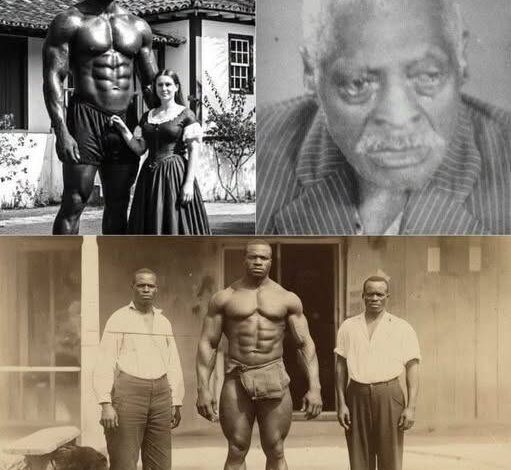
Pata Seca: The 7-Foot-Tall Enslaved Man Whose Life Became a Story of Exploitation, Survival, and an Extraordinary Legacy
In nineteenth-century Brazil, a man named Roque José Florêncio became known for his extraordinary height and a disturbing sto
His body became the defining feature by which others identified him.
But what attracted attention was not height alone.
According to traditional accounts, Roque had relatively thin lower legs compared with his broad upper body. This physical characteristic contributed to the nickname Pata Seca.
To modern readers, the nickname may sound strange or even harmless.
Within the historical context, however, it illustrates how an enslaved person’s identity could be reduced to an anatomical observation.
Instead of being recognized for his personality, intelligence, preferences, or individual experiences, Roque became known for the way his body looked.
More disturbing still was a belief reportedly held by certain slaveholders.
Some accounts claim that tall men with slender legs were thought to be especially likely to father male children.
The reasoning was neither scientific nor medically valid.
A man’s height and leg proportions do not establish that he will father more sons.
Nevertheless, such ideas could appeal to people whose economic interests encouraged them to regard reproduction as a means of expanding their labor force.
Male children were often valued for the physical work they might later be forced to perform, although enslaved women and girls were also exploited through agricultural, domestic, and other forms of labor.
Within this system, the ability of enslaved people to have children could be treated not as an intimate aspect of family life but as an opportunity to increase an owner’s wealth.
The idea that any person’s reproductive capacity could be managed for financial gain represents one of slavery’s most invasive forms of exploitation.
It transformed the body into a resource.
It transformed parenthood into an instrument of ownership.
And it transformed children into potential additions to an inventory.
For Roque, the consequences of these beliefs would allegedly become central to his life.
The Purchase That Changed His Future
Traditional accounts place an important turning point around 1849, when Roque was approximately twenty-two years old.
He is said to have been purchased in Sorocaba by Francisco da Cunha Bueno, the landowner associated with the estate that would become known as Fazenda Santa Eudóxia.
Some later retellings identify this landowner by his noble title, the Viscount of Cunha Bueno.
The specific circumstances of the purchase are not established in the sources available, and dramatic descriptions of conversations or negotiations should be understood as narrative reconstructions rather than documented testimony.
Nevertheless, the broader claim remains central to Roque’s remembered story.
He was reportedly acquired because his physical characteristics were thought to make him particularly valuable for reproduction.
A wealthy slaveholder looking at an enslaved young man could see much more than immediate labor.
He could imagine decades of work, possible resale value, and even future generations who might be compelled into the same system.
Under slavery, such calculations were made possible by the legal treatment of human beings as property.
Ownership created financial claims over people’s labor and profoundly restricted their choices.
For enslaved women especially, pregnancy and childbirth could take place within conditions where owners claimed economic interests in the children they bore.
For men like Roque, stories of reproductive exploitation reveal another dimension of the same institution.
The person at the center of these calculations had little meaningful power to reject the role imposed upon him.
This is what makes the traditional account of Pata Seca so unsettling.
It is not simply that a slaveholder allegedly wanted him to have many children.
It is that the desires, consent, feelings, and relationships of the people involved were subordinated to the interests of ownership.
Whatever the exact details of Roque’s experience, the system surrounding him was one in which freedom could be denied at every level.
His extraordinary body did not protect him from exploitation.
It may have made him a more specific target of it.
And in that sense, the trait that distinguished him from everyone around him also became part of the mechanism by which others sought to control his life.
Life at Santa Eudóxia: Privilege Without Freedom
According to accounts preserved in the region, Roque’s life on the estate differed in certain respects from that of other enslaved workers.
Some retellings suggest that he did not spend all his time working in the coffee fields. Instead, he reportedly performed duties involving animals, transportation, and errands between the estate and nearby settlements.
Other descriptions suggest that his physical presence and the particular role assigned to him gave him a degree of mobility not available to everyone on the plantation.
Such details require caution because they are drawn largely from recollections and stories that developed long after the events themselves.
Yet they raise an important question.
What did different treatment mean to an enslaved person?
An individual might receive better food, different accommodation, or less exhausting work while remaining legally unfree.
Such differences could make daily survival easier, but they did not eliminate the basic relationship of domination.
A person who could be ordered to leave one place, perform a particular task, or enter a relationship without meaningful freedom to refuse was still living under coercion.
Material comfort was not the same as personal autonomy.
This distinction is essential when examining Roque’s story.
The claim that he may have performed duties outside the fields should never be mistaken for evidence that his circumstances were acceptable.
A person could be given special treatment precisely because an owner believed that person possessed unusual economic value.
What appeared to be privilege could therefore be another expression of exploitation.
For Roque, whose body was allegedly viewed through the lens of reproduction, that possibility is particularly disturbing.
To the people who controlled the estate, he may have represented an unusual form of property.
But to himself, he was something no system of ownership could fully define.
He was a man with memories, relationships, feelings, and experiences.
He possessed an inner life that no plantation record could measure.
We do not know the private conversations he had with other workers. We do not know what he thought about the nickname imposed upon him, or how he understood his own unusual height.
We do not know whether he dreamed of leaving the plantation, reuniting with relatives, owning land, or living somewhere beyond the reach of his owner.
The absence of these details does not mean those experiences did not exist.
It means the surviving historical record has preserved only fragments of a much larger human life.
And perhaps that is one of the most important lessons of his story.
Sometimes history tells us far more about the people who held power than about those who endured its consequences.
The Disturbing Allegations About His Children
The most widely circulated claim concerning Pata Seca is that he fathered an extraordinary number of children.
Some versions suggest more than 200. Others place the figure above 250.
The numbers are startling, which helps explain why the
For centuries, slavery had been deeply embedded in Brazil’s economy.
Powerful landowners relied on enslaved labor, and political debates about emancipation were frequently influenced by their financial interests.
Change came through a combination of resistance by enslaved people, organized abolitionist campaigning, legislative developments, and shifts in the broader economy.
In 1850, Brazil passed the Eusébio de Queirós Law, which targeted the transatlantic slave trade.
Although the law represented an important development, it did not end slavery within the country.
People already held in bondage remained enslaved, and the domestic slave trade continued.
In 1871, the Free Womb Law declared that children born to enslaved mothers after its enactment would be legally free, though its provisions allowed continued
Some accounts claim that a substantial proportion of the district’s population could trace ancestry to Pata Seca.
The precise percentage sometimes quoted in popular retellings should not be treated as an established demographic finding without comprehensive genealogical evidence.
Nevertheless, the persistence of that claim illustrates something important.
Roque became a figure around whom a community organized part of its historical memory.
His name connected people to a shared past.
In families, history often survives through repeated stories rather than official monuments.
A grandparent remembers what an older relative said.
A parent passes a story to a child.
A nickname becomes attached to a place, a household, or a family branch.
Over time, these recollections become part of a
These claims are memorable.
They are also incomplete.
They tell us little about what Roque wanted, what he feared, what he valued, or how he understood himself.
And when a person’s historical importance becomes inseparable from astonishing statistics, there is a danger of repeating the same pattern of reduction that defined his treatment under slavery.
He becomes remarkable primarily because of